

MD&A · 2025
In this section4 topics
Overview of Operations
Overview of Operations
Economic Overview and Business Outlook
In 2025, Ocean Glass Public Company Limited and its subsidiaries operated under continued economic pressures and uncertainties in both the global and Thai economies. Key factors included ongoing geopolitical tensions, domestic political uncertainty, and U.S. trade measures, all of which impacted the overall business environment, cost structures, and market demand. At the same time, domestic purchasing power remained fragile due to high household debt levels, while the recovery of the tourism sector has yet to reach its full potential. In addition, certain economic activities in the latter part of the fourth quarter softened compared to the previous year. In response to these conditions, the Company adjusted its strategy by focusing on expanding its customer base while strengthening relationships with existing customers. Efforts were also made to enhance customer access through diversified promotional activities and distribution channels, particularly in the B2B segment and online platforms. These initiatives have been well received and contributed to supporting business performance toward the end of the year. Looking ahead to 2026, the Company expects the Thai economy to continue facing uncertainties driven by external factors, particularly global trade measures and the slowdown in the global economy, which may put pressure on the export sector. Nevertheless, the Company will continue to closely monitor the situation and remain prepared to adapt to evolving conditions. At the same time, the Company will consider supporting factors such as economic stimulus measures, consumption, and tourism recovery from both the public and private sectors, in order to effectively manage risks and capture business opportunities going forward.
Sustainable Development
Beyond adjusting business strategies to cope with economic fluctuations, the Company places significant importance on sustainable business operations. The Company takes into account good corporate governance, as well as environmental and social impacts, to create shared value for all stakeholders, as follows:
Governance
The Company adheres to conducting business with transparency and opposing all forms of corruption. The Company has been continuously certified as a member of the Thai Private Sector Collective Action Against Corruption (CAC). Furthermore, the Company has expanded awareness regarding business ethics and anti-corruption to its business partners to establish transparent operational standards throughout the supply chain.
Environmental
The Company focuses on greenhouse gas management through the Corporate Carbon Footprint Assessment project and the utilization of clean energy by installing solar rooftop systems. This initiative helps reduce energy costs and continuously lowers carbon dioxide emissions. Additionally, the Company has transitioned to recyclable paper packaging to promote the use of renewable resources in major markets, both domestic and international.
Social
The Company continuously conducts volunteer projects by supporting the renovation of school buildings and providing scholarships to schools and communities surrounding the manufacturing plant. This also includes sharing professional knowledge and preparing students from various institutions for the labor market to build a stable foundation for society.
2025 Operating Results
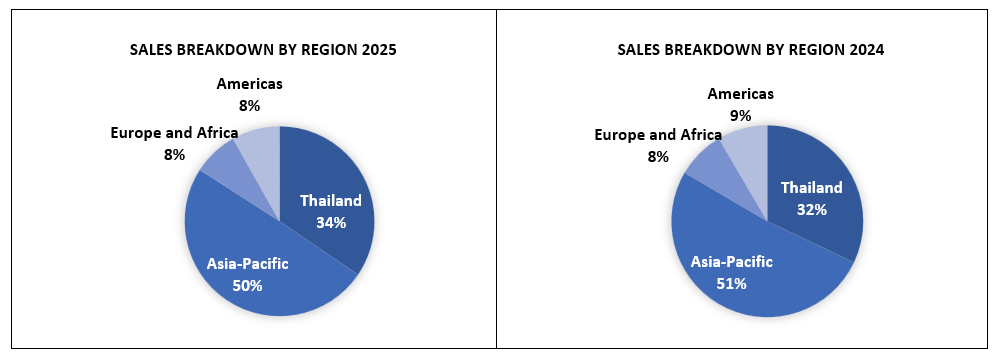
Ocean Glass Public Company Limited and its subsidiaries (“the Company”) reported sales revenue of Baht 1,702.19 million, a decrease of 4.48% compared to the previous year. Sales declined across major countries in Asia, Europe, and the Americas, apart from India, which continued to experience high growth. Meanwhile, sales in Thailand were successfully maintained and grew by 2.86%, driven by sales to Business-to-Business (B2B) customers for marketing and promotional activities during the year-end continuing into the first quarter of 2026, as well as the expansion of online sales channels.
The Company achieved a gross profit margin of 32.84%, a slight increase from the previous year. This was achieved by adjusting the sales mix toward higher-margin products. Despite facing the continuous depreciation of the U.S. Dollar against the Thai Baht in the second half of the year, efficient production cost management and lower energy costs allowed the Company to maintain a gross profit margin similar to the prior year.
The Company recorded a 14.74% decrease in expenses from temporary production shutdowns compared to the previous year to balance inventory levels with sales. Additionally, the Company continued to implement measures to consistently control selling and administrative expenses. As a result, the Company reported a loss before finance costs and income tax of THB 49.05 million, a reduction in loss of THB 24.57 million or 33.37% from the prior year.
However, finance costs increased due to fundraising to support operational and investment activities, coupled with a decrease in tax income. Consequently, the Company reported a total net loss of THB 97.09 million, or a net loss per share of THB 4.55.
Earnings Before Interest, Taxes, Depreciation, and Amortization (EBITDA) stood at THB 165.08 million, an increase of THB 45.85 million or 38.46% from the previous year, reflecting improved operating performance driven by effective cost management and higher production efficiency.
Operating Results & Financial Condition
Operating Results & Profitability
Total revenue was THB 1,723.12 million, 4.42% decrease from the previous year.
1.1 Domestic sales revenue was THB 587.56 million, up 2.86% from the previous year. This increase was driven by the B2B market, resulting from customer orders for year-end marketing and promotional activities that continue into the first quarter of 2026.
1.2 Export sales revenue was THB 1,114.63 million, a 7.95% decrease from the previous year. This was due to the 6.85% depreciation of the U.S. Dollar against the Thai Baht. Furthermore, sales declines in Europe, the Americas, and Asian countries were impacted by geopolitical conflicts manifested through U.S. import tariff measures.
1.3 Foreign exchange gains were THB 3.01 million, a decrease of THB 3.87 million or 56.25% from the previous year. This resulted from the continuous depreciation of the U.S. Dollar against the Thai Baht during the second half of the year
1.4 Other income was THB 13.29 million, an increase of THB 4.26 million or 47.18% year-on-year. This was primarily derived from mold fee income, revenue from the sale of obsolete machinery equipment, and the sale of glass cullet and scrap materials.
Cost of Sales was THB 1,143.23 million, a decrease of THB 64.37 million or 5.33% year-on-year. This decline aligned with lower sales volume and a reduction in energy prices, a primary production cost. Additionally, continuous improvements in production efficiency led to a further reduction in energy consumption.
Gross Profit was THB 558.96 million, decreasing by THB 15.54 million or 2.70% year-on-year. However, the Gross Profit Margin improved to 32.84%, up from 32.24% in the same period last year. This improvement resulted from optimizing the sales mix toward higher-margin products and sustained reductions in production costs through enhanced energy and manufacturing efficiency.
Expenses from temporary production shutdowns to balance inventory levels with sales volume, totaled THB 126.78 million, a decrease of THB 21.91 million or 14.74% year-on-year. This was primarily because the previous year included significant expenses from the scheduled maintenance shutdowns of Soda Lime glass furnaces (Furnace A and Furnace B).
Loss on inventory devaluation was THB 27.52 million, primarily from the write-down of finished goods, raw materials, and obsolete spare parts. This represents a decrease of THB 23.62 million or 46.19% from the prior year. The decline was driven by improved production efficiency, which significantly reduced the volume of crystalline glass products, failing to meet quality standards compared to the previous year.
Distribution Costs amounted to THB 323.93 million, an increase of THB 8.20 million or 2.60% year-on-year. This increase was attributed to intensified marketing and distribution activities aimed at channel expansion during the first half of the year, as well as costs associated with sales booths in department stores and various festivals during the second half of the year.
Administrative Expenses were THB 150.71 million, a decrease of THB 2.64 million or 1.72% compared to the same period last year. This was achieved through continuous cost-control measures. Furthermore, the prior year (2024) included non-recurring losses from the write-off of obsolete assets related to furnace repairs.
Finance Costs were THB 58.75 million, an increase of THB 7.66 million or 14.99% year-on-year. This increase resulted from higher borrowing to support the Company's operational activities and capital investments.
Liquidity & Capital Adequacy
Financial Liquidity
As of December 31, 2025, cash and cash equivalents decreased by THB 18.84 million. The cash flow movements by activity are summarized below:
Net cash provided by operating activities: THB 68.92 million.
Net cash used in investing activities: THB 69.59 million, primarily driven by capital expenditures in machinery and equipment, as well as furnace maintenance.
Net cash used in financing activities: THB 17.08 million, resulting from proactive cash management and the repayment of interest-bearing liabilities.
Asset Management Capability
Assets
As of December 31, 2025, the Company’s total assets amounted to THB 3,875.82 million, a decrease of
THB 51.43 million or 1.31% from THB 3,927.25 million as of December 31, 2024. The change was primarily driven by the following key factors:
Cash and cash equivalents decreased by THB 18.84 million or 40.03%, resulting from short-term loan management for operations, as well as the drawdown and repayment of long-term loans in accordance with loan agreements for asset investments during the year.
Trade and other current receivables increased by THB 7.67 million or 3.40%. This was mainly due to trade receivables pending collection in the first quarter of 2026, offset by a decrease in prepaid expenses as the Company had no plans for major furnace maintenance or significant machinery and equipment purchases at year-end.
Inventories increased by THB 18.60 million, or 1.51%, primarily driven by finished goods and packaging materials. This increase was in line with orders from B2B customers awaiting delivery and production to ensure sufficient stock for sales and promotional activities in the first quarter of 2026.
Property, plant, and equipment decreased by THB 61.22 million or 2.59%. This was the net result of annual depreciation charges and land revaluation adjustments, offset by additional investments in machinery and equipment during the year.
Right-of-use assets increased by THB 14.40 million or 66.67%, due to the renewal of office building leases and new forklift lease agreements entered into during the year.
Debt Obligations & Off-Balance-Sheet Management
Liabilities
As of December 31, 2025, the Company’s total liabilities amounted to THB 2,085.73 million, an increase of THB 6.91 million or 0.33% from THB 2,078.82 million as of December 31, 2024. The changes were primarily driven by the following key factors:
Trade and other current payables decreased by THB 64.60 million or 19.10%, resulting from the deliberate slowdown of raw material procurement to optimize inventory levels, coupled with lower accrued energy expenses as energy prices declined compared to the previous year.
Interest-bearing liabilities, specifically short-term borrowings from financial institutions, increased by THB 30.78 million or 2.82% to support operational cash flow management. Meanwhile, total long-term borrowings from financial institutions increased by THB 28.50 million to align with capital investment projects in machinery, equipment, and furnace maintenance. Additionally, lease liabilities recognized under Thai Financial Reporting Standard No. 16 (TFRS 16) increased by a total of THB 15.74 million. This was due to the recognition of new lease agreements renewed during the year, net of repayments made over the lease terms.
Shareholders’ Equity
As of December 31, 2025, the Company’s total shareholders’ equity was THB 1,790.09 million, a decrease of THB 58.34 million or 3.16% from THB 1,848.43 million as of December 31, 2024. This decrease was primarily due to the recognized net loss for the year, which was partially offset by gains from the remeasurement of employee benefit obligations (net of income tax) and gains from land revaluation (net of income tax) recognized during the period.
Other Analysis
| Title | Description |
|---|---|
| Key Financial Ratios |
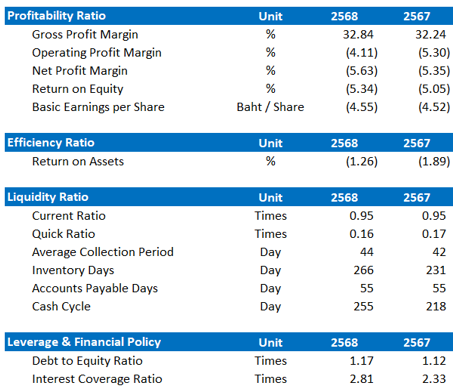
Based on profitability ratios, the Company’s gross profit margin increased slightly from 32.24% in the previous year to 32.84%. This improvement was primarily driven by the strategic adjustment of the sales mix toward products with higher profit margins. Despite the continuous depreciation of the U.S. Dollar against the Thai Baht during the second half of the year, efficient production cost management and lower energy prices enabled the Company to maintain a gross profit margin close to the prior year's level. However, a 4.48% decrease in sales revenue resulted in a net loss per share of THB 4.55 The Company’s Return on Assets (ROA) improved slightly compared to the previous year but remained negative due to the net loss reported for the year. Meanwhile, liquidity ratios reflected a longer cash cycle than the prior year, attributed to higher inventory levels of finished goods and raw material reserves maintained to ensure continuous production. Furthermore, the Company maintained a current ratio of 0.95 times, consistent with the previous year. This was achieved through the effective management of short-term funding sources to ensure adequate liquidity, including bank overdrafts, promissory notes, and international trade finance facilities. |
Debt Securities with Financial Ratio Requirements
Debt Securities with Financial Ratio Requirements Issued?
No
Factors That May Affect Financial Condition
Factors or Incidents That May Materially Affect Financial Condition
Based on the assessment of economic conditions and operational performance over the past year, as well as situations and trends that may occur in early 2569, the factors or events that may significantly impact the financial position and operating results in the future include:
Volatility of Energy Costs Driven by Geopolitical Conflict
Escalating geopolitical conflicts have a significant impact on global energy prices, which constitute a primary cost in the glass manufacturing process. This situation could also lead to increased freight costs. The Company is closely monitoring these developments and evaluating risk mitigation measures, focusing on efficient supply chain management and assessing opportunities for managing energy purchase contracts to minimize the impact on production and transportation costs.
Financial Liquidity and Interest Burden
In 2568, the Company's financial costs increased by 14.99%, primarily due to funding requirements for operations and investments in machinery and equipment. This resulted in higher short-term and long-term interest-bearing debt. Additionally, the cash conversion cycle may lengthen due to inventory management aimed at supporting sales and marketing activities. Should market interest rates remain high, the Company prioritizes liquidity management, efficient inventory turnover, and maintaining financial discipline to control the Debt-to-Equity (D/E) Ratio at an appropriate and sustainable level.
Uncertainty in Trading Partner Economies and Purchasing Power Recovery
International sales, which represent a significant portion of total revenue (approximately 65.48%), declined in the past year, particularly in European and American markets affected by economic slowdowns and trade protectionist measures. While the Indian market continued to show robust growth, the overall global economic outlook for 2569 remains subject to risks from slowing purchasing power, evolving international trade policies, and geopolitical conflicts, which could continuously pressure the Company's export sector. To address these challenges, the Company has adjusted its strategy by focusing on strengthening and increasing its sales proportion in the domestic market. This involves expanding its customer base to include new Business-to-Business (B2B) clients and actively engaging with retail customers through diverse sales promotion activities and accessible distribution channels, as well as enhancing its online sales capabilities.
Adaptation to Sustainability and Evolving Consumer Behavior
Global consumers and trading partners are increasingly prioritizing eco-friendly products, presenting both significant opportunities and challenges. The Company has proactively implemented measures such as installing Solar Rooftops to reduce carbon emissions and electricity costs, and continuously developing recycled packaging. Should the Company successfully elevate its production processes and products to be environmentally friendly as targeted, this will enhance its competitive capabilities, create differentiation, and open access to new customer segments focused on sustainability. Conversely, a delayed adaptation could result in lost business opportunities and exposure to environmental non-tariff trade barriers in the future.
Projects or R&D Affecting Future Results
N/A